
By Stephanie Chong | 26 October 2026 | 7 min read
Key Takeaways
In This Article
A payment gateway is the service that lets your website, app or booking system accept online payments by securely passing the customer’s payment details to the banks and payment networks, then returning an approval or decline in seconds. When choosing a payment gateway in Malaysia, compare the payment methods it supports, how it integrates with your platform, all applicable charges, settlement arrangements, reporting and security.
This guide walks through what happens during an online payment, the methods Malaysian customers expect, how a gateway differs from a merchant account and a POS terminal, and a practical checklist for choosing one.
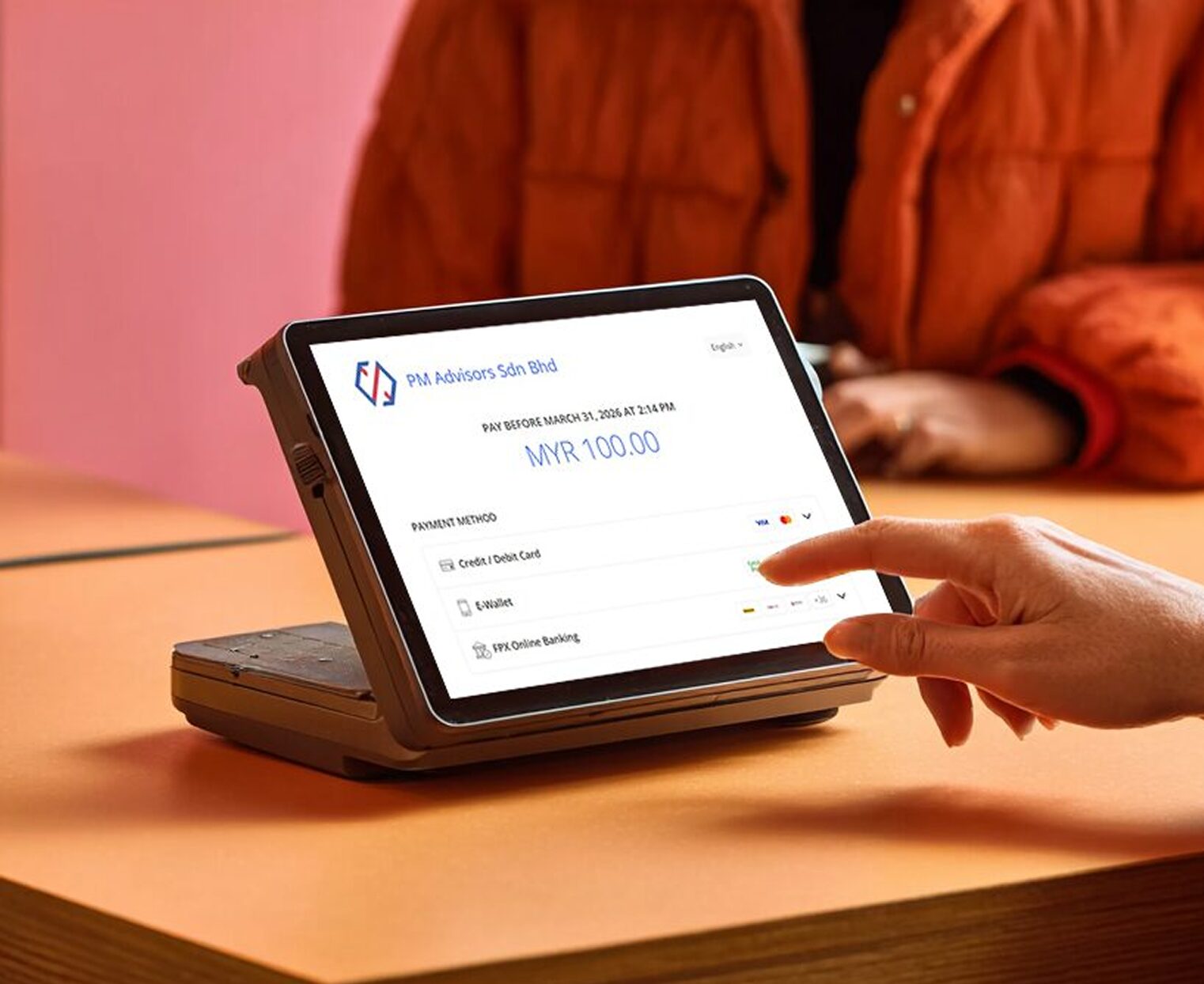
A payment gateway captures the payment at checkout, routes it for authentication and approval, and confirms the result to you and the customer. The whole flow usually completes while the customer waits on the payment page.
A payment gateway in Malaysia should cover cards, online banking, e-wallets and, for higher-value baskets, Buy Now Pay Later. Each method serves a different group of customers, and a missing option often shows up as abandoned checkouts.
Look at your own sales data or customer enquiries before deciding. A tuition centre, an online fashion store and a hotel booking engine will each see a different mix.
The gateway handles the online transaction, the merchant account is where acquired funds are processed before settlement, and the POS terminal handles in-person payments. Most businesses that sell both online and in store need all three to work together.
| Component | What it does | Where it is used |
|---|---|---|
| Payment gateway | Securely captures and routes online payments | Website, app, booking engine, payment links |
| Merchant account | Lets an acquirer process payments for your business and settle them to you | Behind both online and in-store payments |
| POS terminal | Accepts cards, e-wallets and QR in person | Counter, table, front desk or on the move |
If you also take payments face to face, our POS terminal buyer’s checklist covers the in-store side.
Choose on fit with your platform and customers first, then on cost, settlement, reporting and support. A gateway that is cheap but hard to reconcile can cost more in staff time than it saves.
There are three common routes: a ready-made plugin, a direct API integration, or payment links that need no website at all. The right one depends on your platform and your technical resources.
If your store runs on a mainstream e-commerce platform, a plugin is usually the fastest route. Your developer or agency installs it, enters the account credentials and tests a few transactions.
Booking engines, member portals and custom apps typically connect through developer APIs. This gives more control over the checkout experience but needs development and testing time.
Many Malaysian businesses sell through WhatsApp, Instagram or email. A secure payment link lets you send a customer a link to pay by card, e-wallet or bank transfer, with no shopping cart required. It is also a useful way to collect deposits for events, hotel bookings or custom orders.
Whichever route you choose, run test payments for every method before launch and check that each one appears correctly in your dashboard and reports.
Most failed online payments come from authentication that is not completed, details entered incorrectly, insufficient funds or a decline by the customer’s bank. You cannot prevent every failure, but you can stop many of them turning into lost sales.
Keep a simple log of failed transactions for the first few weeks after launch. Patterns appear quickly, and they give your provider the detail needed to help you fix the cause rather than the symptom.
PM Advisors offers e-commerce online payments in partnership with Xendit. You can accept cards, e-wallets, bank transfers and Buy Now Pay Later, send secure payment links, set up recurring payments with auto-debit and automated reminders, and monitor real-time transactions, reports and reconciliation in a centralised dashboard. Developer-friendly APIs connect with e-commerce platforms, booking engines and custom systems.
For businesses with several outlets, our automated reconciliation and sales insights help match sales with settlements. To find out which setup fits your website or booking flow, share your requirements with our team.
A payment gateway is a service that securely captures payment details on your website, app or payment link and routes them to the relevant banks, card schemes or e-wallets for approval. It then returns the result to your checkout so the order can be confirmed, and the funds are settled to your bank account.
Not necessarily. Many gateways offer secure payment links that you can send by WhatsApp, social media or email. The customer opens the link and pays by card, e-wallet or bank transfer. This suits businesses that sell through chat, take deposits or are still building their online store.
FPX is Malaysia’s real-time online banking payment system, operated by Payments Network Malaysia (PayNet). It lets customers pay merchants directly from their bank accounts through their bank’s online banking service, with funds transferred immediately. Many Malaysian online shoppers choose it at checkout instead of a card.
Compare the payment methods supported, how the gateway integrates with your platform, all applicable charges, the settlement schedule, the dashboard and reports, security standards, recurring billing features and the support available. Ask for charges upfront and test the checkout yourself before committing to a provider.
Many can. Recurring payment features let you charge customers automatically on a schedule using auto-debit, with automated reminders before each payment. This suits memberships, tuition fees, subscriptions and instalment plans, and reduces the time your team spends chasing late payments.
About the author: Stephanie Chong
Stephanie Chong writes for PM Advisors on payments, merchant operations and cashless commerce in Malaysia. Her guides turn payment topics such as POS terminals, online payment gateways, e-vouchers and reconciliation into practical steps that business owners can act on.