
By Stephanie Chong | 31 October 2026 | 7 min read
Key Takeaways
In This Article
To accept e-wallet payments in Malaysia, you sign up with a payment provider or acquirer that supports the e-wallets your customers use, then take payments through a multi-payment terminal or QR code at the counter and a payment gateway or payment link online. Once set up, customers pay with apps such as Touch ‘n Go eWallet, GrabPay, Boost or Alipay, or through DuitNow QR, and the funds settle to your registered business bank account.
This guide covers which e-wallets to accept, how in-store and online acceptance work, the steps to get started, and how to handle settlement, refunds and safety.
Accept the e-wallets your customers already use, and add DuitNow QR to cover banking and e-wallet apps that support the national QR standard. If you are unsure, look at what customers ask for at the counter and what your nearby competitors display.
The e-wallets most Malaysian merchants consider are:
Accepting e-wallets is less about following a trend and more about not losing sales. Customers who leave their wallet at home but carry a phone can still pay, small purchases go through quickly without coins and change, and every transaction leaves a digital record you can match to sales. For businesses that already take cards, e-wallets are usually a simple addition on the same terminal.
Non-bank e-wallet operators in Malaysia are regulated by Bank Negara Malaysia as e-money issuers. You can see who holds that status in the BNM Financial Sector Participants Directory.
In-store, the payment happens through a QR code: either the customer scans your code, or you scan the payment code shown in the customer’s app. Both routes end with a confirmation on your device and settlement to your bank account.
You display a QR, either printed or generated on your terminal for the exact bill amount, and the customer scans it with their app and approves. This is the familiar DuitNow QR flow, and our guide to how DuitNow QR works at the counter explains static and dynamic codes in detail.
The customer opens their e-wallet and shows a payment barcode or QR, and your staff scan it with the terminal, where your device and provider support this mode. This is quick at busy counters because the customer does not type an amount.
Whichever route you use, a terminal that accepts e-wallets, DuitNow QR and cards keeps every sale on one device, so end-of-day totals are simple and staff only learn one process.
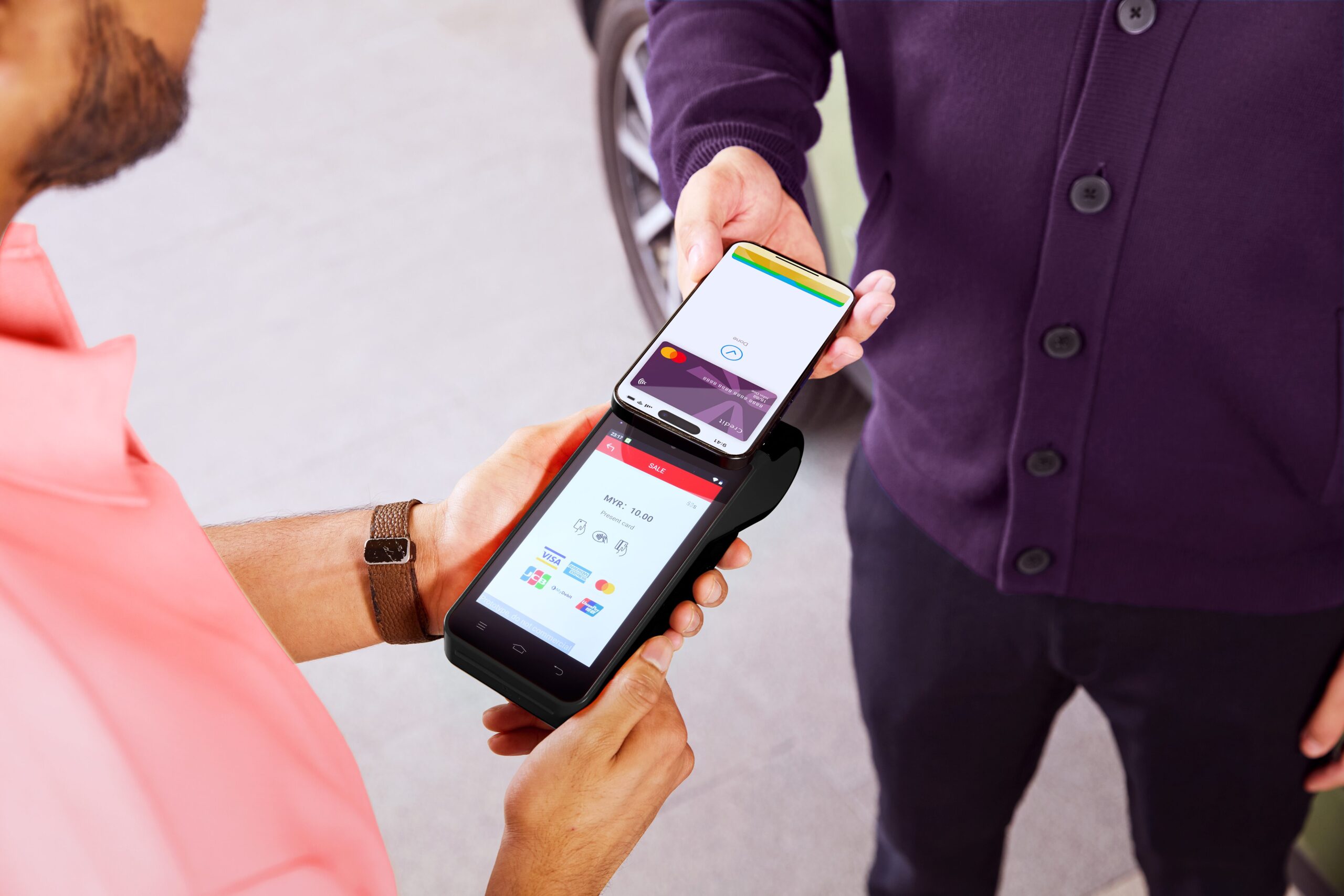
Portability matters too. If you take payment at the table, beside the car or at the customer’s door, a wireless terminal with 4G lets you accept e-wallet payments in Malaysia wherever the sale happens, rather than asking customers to walk to a fixed counter.
Online, you accept e-wallets through a payment gateway on your website or through payment links you send directly to customers. The customer chooses their e-wallet on a secure checkout page and approves the payment in the app.
| Option | Best for | What you need |
|---|---|---|
| Multi-payment terminal | Counters, tables, deliveries, events | Merchant account and terminal |
| Printed static QR | Small stalls and low volumes | QR merchant account |
| Website checkout via gateway | Online stores and booking engines | Gateway account and integration through plugins or APIs |
| Payment link | Social commerce, invoices, deposits | Gateway account, no website needed |
If you sell through WhatsApp or social media, payment links for SMEs are the quickest way to offer e-wallets without building a store.
If you already run an online store or booking engine, a gateway integration through a plugin or API adds e-wallets to your existing checkout. Show the e-wallet options clearly on the payment page, because customers who do not see their preferred method are more likely to abandon the purchase.
Most merchants can go from enquiry to live e-wallet payments by following the same sequence. The exact timeline depends on your provider and on having your documents ready.
With PM Advisors, terminal setup usually takes about one month once all required documents have been submitted, subject to terms and conditions. Gathering your documents early is the simplest way to avoid delays.
New payment options only help if customers know about them. Place logos where customers decide how to pay, not only at the door, and train staff to offer e-wallets when a customer hesitates over cash or card. Review your payment mix after a month to see whether e-wallet use is growing and which apps your customers actually prefer.
E-wallet payments settle to your registered bank account according to the schedule agreed with your provider, and refunds go back through the same channel. Safety mostly comes down to confirming payments on your own device.
E-wallet settlements may arrive separately from card settlements and on their own schedule. Match each channel on its own: compare the e-wallet total on your terminal or dashboard with your POS records daily, then match settlement reports to bank deposits weekly. Record fees separately so the net deposit makes sense.
Always refund through your terminal or provider dashboard so the refund links to the original payment. Sending a separate bank transfer breaks the audit trail and makes reconciliation harder.
PM Advisors’ smart all-in-one POS terminals accept Touch ‘n Go eWallet, GrabPay, Boost, Alipay and DuitNow, together with Visa, Mastercard, MyDebit and UnionPay cards. They connect by 4G, Wi-Fi or Bluetooth, are portable, and include PCI compliance, EMV certification and encrypted transactions.
For online sales, our e-commerce payment solution with Xendit accepts e-wallets, cards, bank transfers and Buy Now Pay Later through checkout integrations and payment links. To add e-wallets to your business, tell us how your customers like to pay and we will recommend the right setup.
Common choices include Touch ‘n Go eWallet, GrabPay, Boost and Alipay, plus DuitNow QR, which covers participating banking and e-wallet apps through one national QR standard. Which ones you can accept depends on your provider and acquirer. PM Advisors’ terminals accept all of these alongside Visa, Mastercard, MyDebit and UnionPay cards in one device.
No. A multi-payment terminal can accept several e-wallets, DuitNow QR and cards in one device, so you do not need a separate QR stand or app for each provider. Keeping everything on one terminal also simplifies end-of-day totals, staff training and reconciliation, because every sale is recorded in the same place.
E-wallet payments are processed by your provider or acquirer and settled to your registered business bank account according to the settlement schedule you agreed. Settlements may be paid net of fees and may arrive separately from card settlements, so reconcile e-wallet payments as their own channel against your sales records and provider reports.
Yes. Payment links let you send a secure checkout page through WhatsApp, email or social media, where the customer can choose an e-wallet and pay in their app. Through PM Advisors’ e-commerce solution with Xendit, payment links accept e-wallets, cards, bank transfers and Buy Now Pay Later, with transactions tracked in one dashboard.
Issue the refund through your terminal or your provider’s dashboard so it links back to the original transaction and returns to the customer’s e-wallet. Avoid refunding by separate bank transfer or cash, because that breaks the audit trail and makes reconciliation harder. Limit refund permissions to trusted staff and review refunds at the end of every shift.
About the author: Stephanie Chong
Stephanie Chong writes for PM Advisors on payments, merchant operations and cashless commerce in Malaysia. Her guides turn payment topics such as POS terminals, online payment gateways, e-vouchers and reconciliation into practical steps that business owners can act on.